
Remember Movie Theaters?

Remember Movie Theaters?

Sure, they still exist. You can still find the marquees lit up, the recliner seats, the overpriced popcorn. But it’s not the same. Not like it used to be.

I remember being a kid in the 90’s—when going to the movies was a ritual. We’d pile into the car and hit the theater two, three times a month. You didn’t scroll through trailers on your phone. You didn’t wait for the stream to drop. You went, in person, to see it now.

There was nothing like it. Picking the movie. Grabbing a bunch of junk food. Finding your seat before the lights dimmed. The smell of buttered popcorn that clung to your shirt. The buzz of the crowd waiting for the previews. The collective gasp when the hero showed up, the villain got crushed, or the credits rolled on a twist ending.

It wasn’t just about the movie. It was the event. The ritual. The presence. You don’t get that anymore.

Now? Movies trickle onto streaming platforms weeks later. Everyone’s got their own screen, their own couch, their own snacks. Comfort has replaced ritual. Convenience has replaced community.

And maybe that’s what we’ve lost—not the theaters, but the shared experience. The showing up. The anticipation. The energy that only happens when you’re there.

That’s the danger of this “on-demand” world—it makes everything easier, but it strips away the weight of the moment. It steals the rituals that give life its rhythm.

The plight of the movie theater reminds us of something deeper: rituals matter. Shared presence matters. Don’t let convenience rob you of the experiences that shape your story.

The (Flavor) Simulation

The (Flavor) Simulation

Brother, I realized something the other day: we’re living in a simulation.

Not a computer simulation—a flavor simulation.

I was sipping a sports drink labeled “naturally berry flavored” (whatever that even means). But here’s the thing—there wasn’t a berry within 10 miles of that bottle. No juice. No pulp. No smashed blueberries. Just lab-derived flavor molecules convincing my brain: “Yup, fresh berries, brother.”

For all intents and purposes, I was in a flavor simulation.

And it kind of messed with me. My conscious brain knew this wasn’t berry. But my subconscious was all in—taste buds firing, dopamine flowing. It was both berry…and not berry.

Like drinking grape soda. That’s grape? Not a chance.
Banana candy? No banana in sight.

So which one is real?

The chemical trick my brain interprets as real?

Or the fact that the source itself isn’t real at all?

And then the heavier question hits: isn’t that just…everything?

We don’t know anything outside of our brains interpreting it.

Reality itself might just be a flavor simulation.

But hey—maybe that’s too deep for a Saturday. 🤣

Maybe the Builder move is simpler: taste the flavor, enjoy the ride, but don’t get lost in the simulation.

In Need of Some Quiet, Brother? Here’s Earth’s Quietest Place

In Need of Some Quiet, Brother? Here’s Earth’s Quietest Place

We live in a world of constant noise.

Traffic. Notifications. TVs blaring. People talking just to talk.

But what if I told you there’s a place so quiet you can hear yourself blink?

That place exists—right here on Earth.

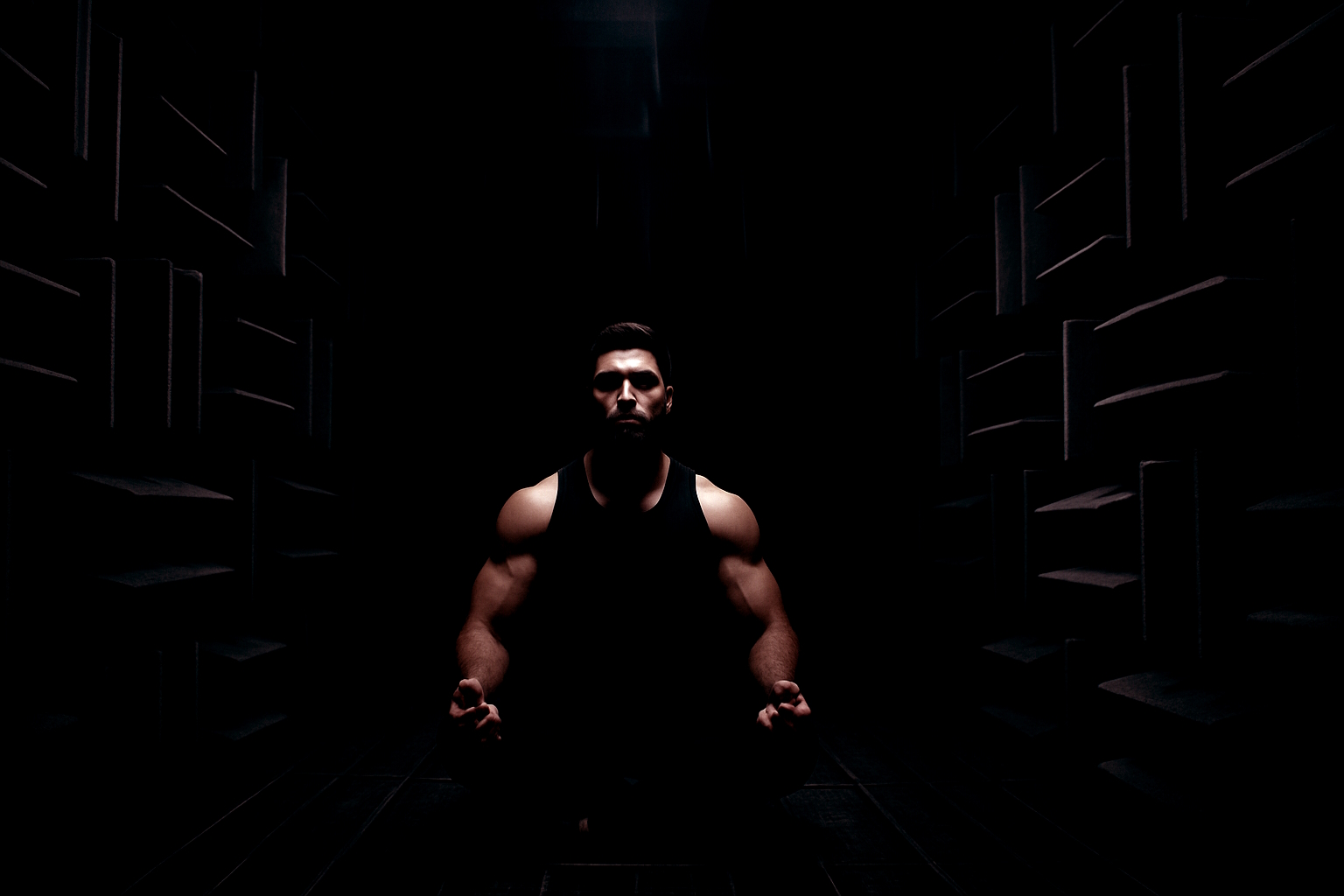
At Orfield Labs in Minnesota, there’s an anechoic chamber—a room so soundproof it holds the Guinness World Record for silence. Inside, sound is measured at –24.9 dBA.

That’s quieter than outer space.

It’s so silent you can hear your heartbeat. Your lungs filling with air. Your joints shifting as you move. Most people don’t last longer than an hour before the silence drives them insane.

The Forge of Silence

For the average person, silence is torture.

For the Builder, silence can be a weapon.

Imagine stepping into that chamber, shutting the world out, and locking in.

No noise. No distractions. Just you, your breath, your mind.

  • Breathwork in the absolute void.
  • Meditation so deep it feels like another dimension.
  • Maybe even sleep so pure you wake up reborn.

The question isn’t could you handle it?

The question is: what would you build in there?

Anchors Down in the Quiet

Noise is everywhere, brother. But you don’t need the chamber to experience quiet (although it would be cool to check out!).

No, just close the windows, draw the curtains, and sit with yourself. Remote spots out in nature can also work.

Face the silence, build in it, and come out stronger than the noise.

Read more over at Smithsonian Magazine.

What If the Titanic Had Hit the Iceberg Head-On?

What If the Titanic Had Hit the Iceberg Head-On?

From the Brickyard | Subject: A lesson from the tragedy

——

Most people know how the Titanic went down.

Big ship. Cold night. Iceberg. Tragedy.

But here’s a question that doesn’t get asked enough—and when it does, it changes everything:

What if the Titanic hadn’t turned? What if she hit the iceberg head-on instead of trying to dodge it?

Sounds crazy, right?

But here’s the wild truth…

If Titanic had rammed that iceberg straight on, she probably wouldn’t have sunk.

A Different Kind of Impact

Titanic tried to turn left (port) and reverse engines to avoid the iceberg. But all that did was put her more in harm’s way.

Why?

It all has to do with her watertight compartments.

She was built so she could stay afloat with four compartments flooded, which was thought to make her so safe she was called the unsinkable ship.

But turning made the ‘berg scrape along her side in the worst way possible—tearing open five compartments.

That was game over.

Now imagine this:

Instead of swerving, Titanic slams into the iceberg dead center.

The bow takes the blow. One or two compartments crushed. Water rushing in, yes—but she likely stays afloat.

It would’ve been like a hundred train wrecks at once—violent. Brutal. Absolute carnage. But not a full-scale sinking.

Thousands more lives could’ve been saved.

The Brickwall Takeaway

And here’s where the story stops being about ships and starts being about you.

Sometimes, the move that feels safer—the dodge, the delay, the detour—is the one that dooms you.

How often do we flinch, swerve, stall…and end up taking damage we could’ve survived if we’d just faced it head-on?

In training.

In business.

In relationships.

It’s not always the hit that breaks you.

It’s the way you respond to it.

You’ve Got Your Own Icebergs

Maybe it’s a conversation you’ve been avoiding.

A decision you keep putting off.

A truth you hope will miss you if you just turn away.

But the longer you dodge, the worse the damage gets.

Sometimes the best move is to brace yourself, tighten your grip, and smash into that fucking iceberg head-on.

Here’s Your Challenge

Stop swerving.

Stop dodging.

Stop bleeding out from a thousand cuts.

Find the icebergs you’ve been avoiding—and hit them.

Head-on.

No flinch.

No panic.

Take the hit. Stay afloat. Better your life.

Brick by brick.

-Brickwall

Those Final Two and a Half Minutes of Stairway to Heaven

Those Final Two and a Half Minutes of Stairway to Heaven

Robert Plant stops singing. You hear Jimmy Page’s guitar, John Paul Jones’ bass, and John Bonham’s drums all in sync…and you know—it’s about to go down.

It’s about to get real.

The first 5:30? Beautiful, haunting, setting the stage. But they’re the buildup. The storm clouds. The slow tightening of the spring.

Then it hits.

That guitar solo. Robert Plant’s urgent vocals. The tempo shift. The feeling like the horse is on fire but you’re riding it anyway.

The last two and a half minutes of Stairway to Heaven aren’t just music—they’re pure ignition. A release. The soundtrack to pushing through your last brutal set, to finding clarity in chaos, to unleashing what’s been boiling inside.

It hits so hard, you don’t just hear it…you feel it.

Stairway to Heaven is a microcosm of the Musclebuilder’s life.

Calmly, methodically stacking bricks. Nose to the grindstone. Steady progress.

But then—you whale on that guitar and bass, hammer those drums, scream your war cry.

It’s GO time.

You ignite.

Anchors up.

It could be in the gym.

It could be in business.

It could be anywhere.

But you thrust yourself into the battle and start climbing.

Full fucking send.

Climb that stairway, brother—that stairway to something better.

The Greatest Hold Song You’ll Ever Hear: Opus No. 1 by Tim Carleton

Picture it, brother.

You’re jumping through hoops—trapped in corporate purgatory, trying to get your issue solved. Ear to phone, precious time slipping by.

Frustrating, no doubt.

Then you hear the groove…

A synth line smoother than glass. A bass that hums like a steel chain dragging across the floor of the Brickyard. A rhythm that makes even purgatory feel like a dance floor.

That’s Opus No. 1 by Tim Carleton.

And whether you know it or not, you’ve been initiated.

The Hidden Anthem

Opus No. 1 isn’t just hold music. It’s the secret soundtrack of the grind.

  • It’s been echoing through phone lines since 1994, quietly infiltrating millions of ears.
  • It’s survived generations of customer service agents, outlasting trends, outlasting even the companies themselves.
  • It’s a song nobody asked for, yet just about every man alive has heard.

It’s the anthem of waiting warriors, brother. The track you never chose—but somehow chose you.

The Brickyard Is Everywhere

In the Brickyard, we talk about forging muscle under load. Training in the fire. Holding the line when life tries to break you.

Opus No. 1 is that lesson in music form.

It teaches patience through groove. Discipline through rhythm. A reminder that even in the most soul-sucking places—the DMV, the bank, the endless queue—you can still find flow.

It’s the Mona Lisa of Muzak.

The Chain On, Gains On of waiting.

The percent zone of patience.

Rally Call

Brother, next time you’re on hold—don’t get pissed. Get groovy.

Listen. Feel it.

That’s Opus No. 1 whispering the Brickyard truth:

You’re not just built with the weights. You’re built in the waiting, too.

Every queue. Every delay. Every grind you endure.

The groove forges you.

So when life puts you on hold?

Find the rhythm. Lock in. Build anyway.

Anchors Down. Anchors Up. Groove in the Grind.

Even hold music can be Brickyard.

Do Aliens Really Exist?

We’ve all stared up at the night sky.

Dark. Endless. Full of stars that make your problems look like gnats on a 100 lbs dumbbell.

And sooner or later, the thought hits you: are we alone?

Let’s break this thing down Brickwall-style and see if we can finally settle it (maybe 🤣).

The Math Don’t Lie

The universe isn’t just big—it’s insanely, pre-workout overdose big.

There are 200–400 billion stars in our Milky Way.

About 2 trillion galaxies in the observable universe.

And countless planets spinning around all that.

Even if life is rare, the numbers are so outrageous that something’s probably out there.

The Drake Equation is basically the cosmic spreadsheet saying: “Brother, odds are high you’re not lifting alone.”

The Hard Part: Life vs. Builders

Microbes? Easy. They’re the roaches of the universe. Toss ‘em on Mars, Europa, or Titan, they’ll probably squat there.

Complex life? Now we’re talking. Took Earth 4 billion years to get from slime to us.

Civilizations? That’s the elite tier. Intelligence might not be evolution’s default—maybe it’s just Earth flexing hard while other planets skipped leg day.

The Fermi Paradox: Where the Hell Are They?

If life’s out there, why hasn’t some alien bro walked into the Brickyard asking for a spot?

Maybe they’re too far (speed of light = universal governor).

Maybe advanced civilizations get destroyed often (nukes, plagues, meteors, etc.).

Or maybe we’re rookies in the galactic gym and the vets don’t even bother watching our sets yet.

UFOs, UAPs, and the Noise

Sure, governments admit there’s weird stuff in the sky.

Could it be aliens? Sure.

It could also be tech we don’t understand.

It could even be smoke, mirrors, and psy-ops.

Verdict? Until a gray-skinned dude curls meteorites in front of me, it’s all just noise.

The Heavy Question: Does It Even Matter?

If aliens exist—awesome. If they don’t—then we’re it.

The only story. The only builders.

Either way, the mission doesn’t change:

  • Build.
  • Live.
  • Rise.

Because whether we’re alone in the cosmos or not, it’s on us to stack the bricks here on Earth.

Final Verdict

Could aliens exist? Hell yes. Math is screaming it.

Will we meet them? Slim chance anytime soon.

Does it change our mission? Not one rep.

Brother, don’t wait for a cosmic spotter to hand you the weight.

Whether or not some alien’s out there benching black holes, you’ve got the weight in front of you right now.

Lift it. Build it. Make life worth living.

Is the Word “Thru” Ever Grammatically Correct?

Ever notice that certain road and construction signs ditch through for the leaner, meaner thru?

That got me thinking: is thru actually a “real” word—or did sign makers just decide, “Eh, everyone will get it, and it saves three letters”?

After far too much digging (more than any sane person would do), I’ve got the verdict: thru is indeed legit…in certain situations.

Where you can use “thru” without the grammar police coming after you:

  • Personal notes or messages – Texts, sticky notes, love letters. The people reading them will get your point. (Although a few grammar sticklers—myself included—might twitch.)
  • Technical uses – Road signs, airport directions, computer code. Here, clarity beats style. Nobody’s grading your syntax when they’re trying to figure out if they can go thru.

Where “thru” is not advised:

  • Formal writing – Emails to your boss, academic papers, job applications. Thru here feels sloppy, like wearing sweatpants to a wedding.

So, the safe play? Just use through everywhere unless you’ve got a specific, functional reason not to. Yeah, it’s three extra letters every time. Yeah, it’s mildly annoying. But it becomes automatic, and you’ll never get a passive-aggressive “correction” from some know-it-all.

Alright, I’m thru…I mean, through. 🤣